
Substack for Photographers: The Guide Nobody Finishes
Most of you have an account. Almost none of you have a publication.

If you’re not chasing clients or licensing income from photography, the question is fair: why not just keep posting on Instagram, where everyone already is?
A few honest answers.
Instagram is a rented room. The algorithm decides who sees your work, that decision changes without notice, and none of your followers are actually yours, they belong to the platform. On Substack, if a hundred people subscribe to you, a hundred people get your work in their inbox. No algorithm decides whether today’s post is worth showing them.
A caption is not a place to think. Substack gives you room to write what actually happened on a shoot, why an image matters to you, what you were trying to do and whether it worked. For anyone who shoots because they think in images and want to think in words too, that space doesn’t exist anywhere else in the same form.
Instagram compresses everything, literally and otherwise. Your images get flattened in quality and your thinking gets flattened into a caption’s worth of space. Neither serves the work.
It’s not about money. Most people on Substack, photographers included, never charge for anything. The value is having one place that’s actually yours, an archive that doesn’t vanish under a feed, doesn’t compete with a hundred unrelated posts for attention, and isn’t subject to a platform’s next policy change.
And it’s quieter. No follower count on display, no like button training you to chase a number. Just people who chose, specifically, to keep reading you.
You don’t need an audience of thousands or a business plan to get something out of that. You need one honest reason to write, and a place that won’t bury it by tomorrow.
Why listen to me on this
I’ve spent over thirty-five years behind a camera, and a good part of that on the other side of the desk too, as an assignment editor at Getty Images and Corbis and many other outlets, deciding what got published and what didn’t. I know what a working photographer’s relationship with a platform actually looks like from both directions.
None of that is why I’m writing this piece. I’m writing it because I’ve spent the past year treating my own Substack the way I used to treat an assignment, tracking what actually gets read, what gets restacked, what converts a stranger into a subscriber and what just sits there.
In that first year: seven thousand followers, fifty-three hundred subscribers, hundreds of them paid, more than forty thousand page views a month. None of that happened by posting and hoping. It happened by testing three distinct Note formats against real numbers, observing which pieces actually converted a reader into a subscriber, and raising prices only after the value behind them had already been proven.
I’m not telling you what should work. I’m telling you what did.
None of what follows requires chasing those numbers. The fundamentals are identical whether you want thousands of subscribers or forty people who found you through one photograph they couldn’t stop looking at. And most photographers, regardless of what they’re chasing, get the fundamentals wrong before they ever find out what they’re capable of pulling in.
A few weeks ago I looked up a photographer I know on Substack. Good eye, real career, work I respect. His profile had no bio. No mention of what he shoots, or that he shoots at all. Just a name, an avatar that could belong to anyone, and a Subscribe button asking me to commit to something I couldn’t identify. He could have been a novelist. A dog breeder. Nothing on the page told me otherwise.
This is not a rare case. It is close to the default. Most photographers arrive on Substack, set up an account in ten minutes, publish a few pieces, and never go back to finish the job. The result is a storefront with the lights on and the sign missing.
Part of this is habit. Instagram trained an entire generation of photographers to think of an online presence as a grid. Post the work, let the image carry the message, keep the words to a caption. Substack asks for the opposite. Here the words are not decoration around the image. They are the structure the image lives inside. Your bio is not a formality under a handle. Your About page is not a CV nobody reads. They are the first pitch a stranger sees before they decide whether to give you their inbox, which is a far more valuable thing to be given than a follow.
None of what follows is complicated. Most of it takes an evening. The reason it stays unfinished is that photographers keep importing Instagram habits into a place that runs on different rules. So let’s go through it properly, piece by piece, the way I’d walk a friend through it before they touched Substack for the first time.
Your profile picture and name
Use a real photo of yourself, not a logo, not an illustration, not an abstract avatar. People subscribe to people, especially in a field built on trust and eye. If you shoot editorial or documentary work, a plain, well-lit portrait does more work than any graphic ever will. Use your real name in the name field, not a brand name, unless that brand already carries its own recognition. A stranger scrolling Notes should know who you are in half a second, not guess.
Your bio line
This sits under your name everywhere your profile appears: on Notes, on comments, on your About page, in search previews. Keep it under thirty words. State what you shoot, then one credibility marker, then one specific detail that makes you memorable. Something like: documentary and editorial photographer, contributor to major agencies, based between two cities you actually work in. Not a mission statement. A fact pattern a stranger can verify and remember.
Your About page
This is your pitch, not your resume. Four moves, in order. First line states what you do and why it matters, one sentence, no throat clearing. Second paragraph gives credibility: years of experience, notable clients, agencies, publications, kept to three or four lines, specific rather than vague. Third paragraph tells the reader what they get if they subscribe: what kind of writing, how often, what’s behind the paywall if anything, described in concrete terms rather than promises. Close with one clear line asking them to subscribe. Four short paragraphs. Most photographers either skip this page or turn it into a full CV. Neither converts a stranger into a reader.
Your publication name and tagline
The name should be memorable and searchable, not clever for its own sake. Avoid puns that only make sense once someone already knows your work. The tagline sits under it in previews and search results and should say plainly what the publication is. Not “thoughts and photos.” Something a stranger could type into a search bar and actually mean.
Your categories
Substack has you pick a primary and secondary category when you set up your publication. This is not a formality, it affects who finds you through browse and recommendations. Choose the category your work most clearly fits first, a secondary that reflects a genuine second angle of what you write about second. This is not permanent. Revisit it if your content shifts.
Your cover image and post images
This is where photographers usually do better than anyone else on the platform, and also where they make the most avoidable mistakes. Your publication’s cover image should be a strong, single frame that represents your eye at a glance, not a collage, not a logo. For individual posts, lead with one image that earns the click, not four competing for attention. Compress before you upload. Substack will render large files, but slow-loading images cost you readers in the first three seconds, before they’ve read a word.
If you’re publishing a photo essay format, a piece built primarily around a sequence of images with shorter text between them, keep a consistent rhythm: image, one or two paragraphs, image, rather than dumping a gallery and writing underneath it as an afterthought. Alt text matters here too, both for accessibility and because it’s one more place your work becomes searchable.
Protecting your work
You license through agencies, so this matters more for you than for a hobbyist. Substack does not offer built-in watermarking or right-click protection. If that concerns you, downsize your images to web resolution before uploading, strip identifying EXIF data if you don’t want it public, and consider a subtle signature or credit line baked into the image itself rather than relying on the platform. Full-resolution files should never leave your own systems. Substack is a publishing platform, not a delivery mechanism for licensable work.
With identity and images settled, the next question is activity.
Your first Notes
Post a handful of Notes before you expect anyone new to find your articles. Notes are shown to non-subscribers and indexed the way a feed is, which means an empty Notes history is often the first thing a curious visitor sees, and it reads as inactivity. You don’t need a strategy yet, you need presence. A short craft observation, a quick opinion, a line from a shoot. Get five or six up before worrying about frequency or format.
Your recommendations
Follow and recommend five to ten publications that sit near your niche: other photographers, visual culture writers, adjacent crafts. This is not just generosity, it’s how Substack’s internal discovery starts connecting your publication to relevant readers. A profile that recommends nothing looks disconnected from the platform, and it gets treated that way.
Your archive before you launch
Have two or three posts live before you promote the publication anywhere. A visitor who clicks through and finds one post assumes the project just started, or already stalled. Three posts read as a publication. One reads as a test.
That covers what a stranger sees before they subscribe. What happens the moment after matters just as much.
Your welcome page and welcome email
When someone subscribes, Substack lets you customize what they see next and what lands in their inbox first. Most photographers leave this on the default. Don’t. Write a short welcome note, two or three lines, telling a new subscriber what to expect and how often. This is the only piece of writing you’re guaranteed every subscriber will see. Treat it that way.
Your paid tier, if you have one
If you’re charging, be specific about what a paid subscription actually includes, not “exclusive content,” which means nothing to a stranger. A monthly extra piece, a downloadable resource, a recurring feature like a critique or Q&A session, whatever it is, name it on your pricing page in concrete terms. A founding member tier, priced above your standard annual rate, gives your most invested readers a way to support you beyond the transaction, and costs you nothing to set up.
As your archive grows, especially across more than one kind of writing, organization becomes its own decision.
Sections, if you write about more than one thing
If your publication covers more than a single throughline- craft pieces and business pieces, for instance- Substack lets you organise content into sections so a reader can subscribe to what they actually want rather than everything. This isn’t necessary on day one. It becomes useful once you have enough of an archive that a new visitor needs a way to navigate it.
Organisation is structure. The last lever before design is more personal.
Chat and discussion threads
Substack’s chat feature and comment threads are underused by almost everyone outside the platform’s power users. You don’t need to run a chat, but enabling comments and actually replying to the first few you get costs nothing and signals that there’s a person behind the publication, not a broadcast.
Everything so far has been substance and interaction. The last piece is how it actually looks.
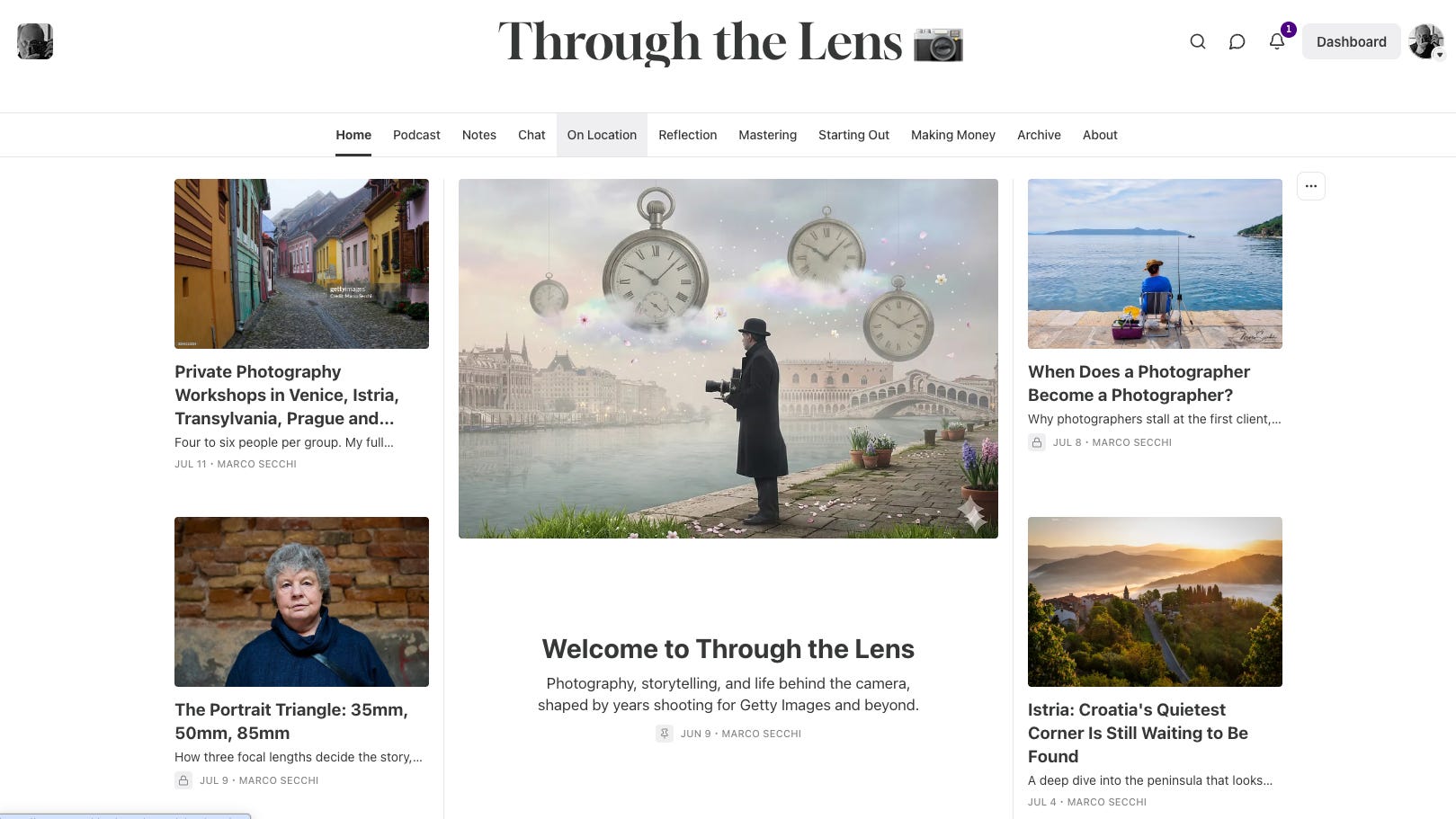
The website itself (Settings > Website > Theme Editor)
This is where most photographers leave the most value on the table. You have the eye already; this section rewards it directly.
Logo and wordmark: upload a real logo, minimum 256x256px, appears top-left of your publication and as your email favicon. If you don’t have a mark, your publication name in a clean font works fine, don’t force a logo that isn’t ready.
Cover photo, your welcome page: this is the first full-bleed image a brand-new visitor sees, before anything else. For a photographer, this should never be a stock image or a graphic. Use one of your own frames, the strongest single image you have, the one that says who you are before anyone reads a word. This is free real estate almost nobody in your field uses properly.
Accent colour: controls your subscribe button and link colours. Pull it from your own work rather than guessing; a tone that actually appears in your photography reads as intentional rather than decorative.
Fonts: the title and body fonts are separate choices. A serif title with a clean sans body reads editorial, which suits documentary and reportage work. Don’t touch more than title and body; more choices just introduce inconsistency.
Homepage layout: Substack offers a few layouts: list, grid, and magazine style with a featured post up top. For photographers, a grid or magazine layout with a strong hero image outperforms a plain list, since it lets the images themselves do the selling on the homepage, not just the headlines.
Hero post: you can pin one post to the top of your homepage regardless of publish date. Pin the single piece that best introduces a first time visitor to what you do, not necessarily your most recent.
One caution: design is a well known procrastination trap on Substack. Ten minutes tweaking colors and fonts is enough, the platform’s default theme is solid on its own. The real leverage is in the bio, the About page, and the first posts, not the palette.
Once the page looks the way you want it to, stop touching it and start watching what actually happens.
What to watch in the first month
Ignore the subscriber count for now, it’s the least useful number early on. Watch your open rate, which tells you whether the people who did subscribe are actually reading. Watch restacks, which tell you what’s resonating enough that someone put their own name next to it. Watch which Notes get replies versus which get scrolled past. These tell you far more about whether this is working than raw follower growth ever will.
None of this, on its own, is difficult. What’s difficult is that most photographers do two or three of these things and stop, assuming the writing alone will carry the rest. It won’t. The writing is what earns someone’s attention for five minutes. The setup is what determines whether they come back for the sixth.
An empty profile, in the middle of all this, is a closed door with a welcome mat in front of it.
Fix the door first.
If you want the condensed version of everything above, a working checklist you can run through step by step without re-reading the full piece, that’s available for paid subscribers below.
